
Active Galactic Nuclei
AGNActive Galactic Nuclei (AGN) are the bustling centers of some galaxies that pack an impressive punch of energy, often radiating light across the universe like cosmic beacons. These energetic hotspots primarily arise from the supermassive black holes that reside at their cores, gobbling up surrounding matter and unleashing spectacular amounts of radiation in the process. In the vastness of the cosmos, AGN are the rock stars, drawing the attention of astronomers and space enthusiasts alike!
"The Hubble Space Telescope has captured stunning images of active galactic nuclei, allowing astronomers to study the dynamics of matter falling into supermassive black holes and its effects on galaxy evolution."
Explained For Every Age ✈️
The same concept, told in 4 magical ways

Once upon a time in the big, wide sky, there was a super bright starship that loved to zoom around. Whenever it opened its mouth to sing, beautiful lights danced all around, making friends with the shiny planets nearby!
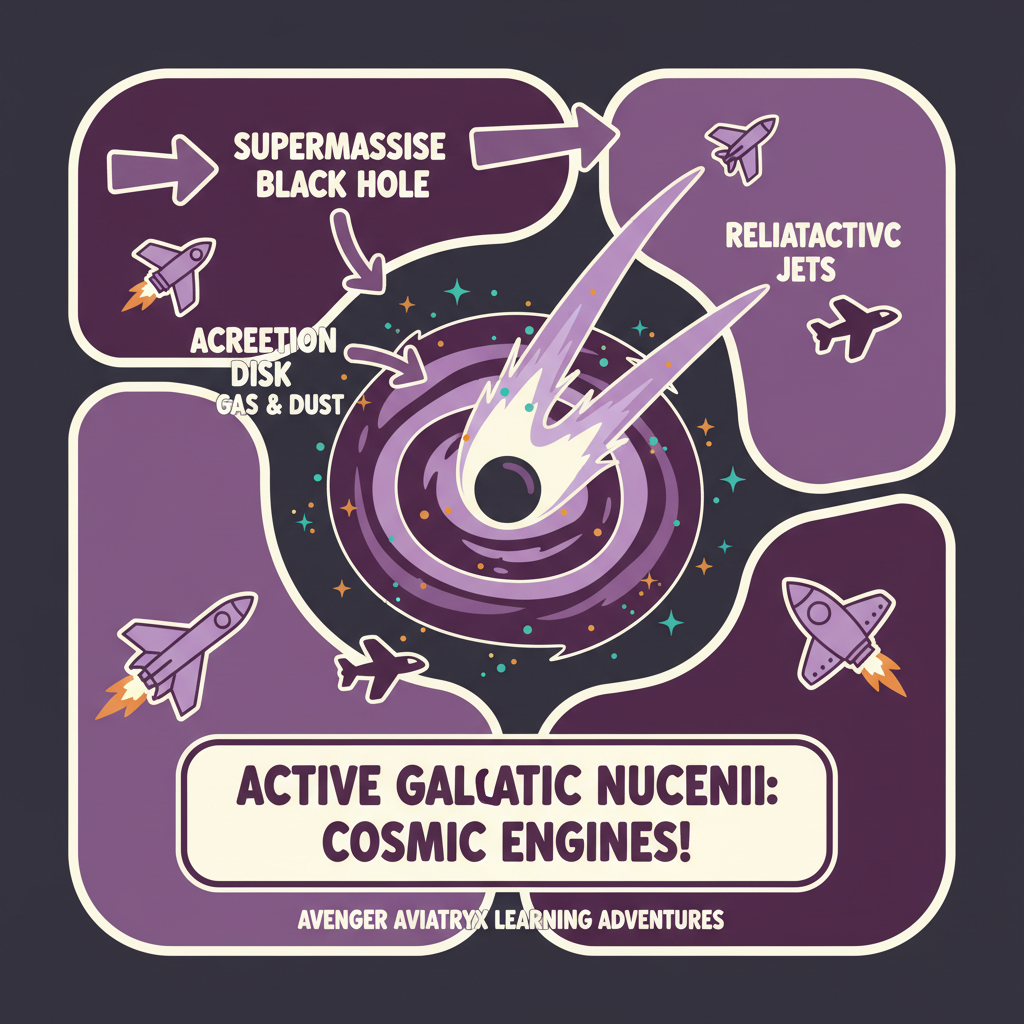
In the vast universe, there are incredible places where stars and planets twinkle like fireworks; one special spot is an active galactic nucleus! Imagine a giant black hole at the center of a galaxy, gathering space snacks like gas and dust, and when it does, it lights up like a Christmas tree. These magical places help us learn about how galaxies grow and change over billions of years!

An active galactic nucleus is a fascinating area in some galaxies, powered by a supermassive black hole that can exert gravitational forces strong enough to pull in surrounding matter. As this matter spirals inward, it heats up and emits tremendous amounts of energy, visible across light years. Studying AGN not only enriches our understanding of black holes and galaxy dynamics but also provides insights into the formation of the universe itself. AGN can be viewed as both shimmering beacons of energy and laboratories for astrophysical processes, making them significant to space exploration and study.

Active Galactic Nuclei (AGN) are critical to our understanding of galactic formation and evolution. They represent the energetic output from supermassive black holes at the centers of galaxies, where material accretes, generates immense radiation, and influences the environment around it. In practical terms, observing AGN helps astronomers assess the rate of black hole growth and its impact on galaxy dynamics, allowing for predictions concerning star formation and galactic interactions. For instance, studying the light curves of a quasar, a type of AGN, can yield important information regarding the mass of the black hole and the structure of the accretion disk. As advances in telescope technology continue to improve our observational capabilities, the mysteries surrounding these spectacular cosmic phenomena become ever clearer.